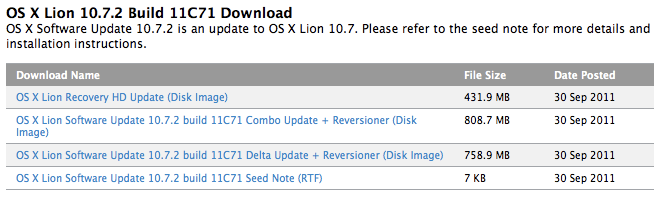
Apple has started seeding a new Lion 10.7.2 (11C71) build to developers, though it is not yet appearing to all developers. The new build lists no new issues and includes a Lion Recovery Update which includes improvements to Lion Recovery and addresses an issue with Find My Mac when using a firmware password.
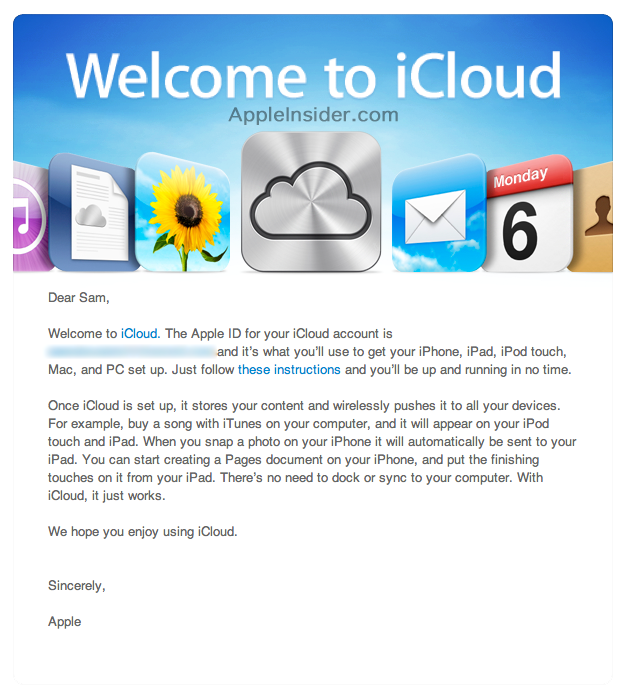
Apple has also sent out some premature iCloud welcome emails. AppleInsider publishes a welcome email that was sent to one of its readers:
The link to the instructions found in the email is not yet active. Apple must be making final preparations to launch iCloud. iCloud is expected to launch alongside iOS 5. We should hear more about the service at next week's media event which takes place on October 4th.
Amazon's Kindle Fire is being sold at a loss to heat up competition with Barnes & Noble and Apple, IHS iSuppli estimated Friday. Based on a list of known and expected components, it believes the seven-inch mini tablet costs $209.63 in raw parts and manufacturing, or about $10 less than its $$199 asking price. A high-quality IPS-based LCD at $87 is a large part of that cost, while adding the dual-core TI OMAP processor and other mainboard components pushes it up by another $70.40....
If you've got an iPod classic, or one of the older click-wheel generation iPods, why not give the old wheel a swan song performance over the weekend and take some of the old, classic games (Brick, Vortex, iQuiz to name a few) for a spin.
The message list in Lion's version of Mail displays each message's date or time received. But with a few System Preferences tweaks, you can make Mail show both the date and the time simultaneously.
Over the years, I've had the opportunity to try out a number of products from OtterBox. The company, based in Fort Collins, Colorado, is well known for their protective cases for iOS and other devices. The company has four main series of products: the Defender, a multi-layer design which is designed for rough conditions; the Reflex, which uses a lighter design that emulates the automobile crumple zone concept for protection; the Commuter, which is designed for protection from day-to-day drops and scrapes; and the Impact, which is made up of simple silicone sleeves. OtterBox is about to ship the new Reflex series case for iPad 2 (US$69.95), and I had a chance to try it out. Read on for more details on this new iPad 2 case.
Design
As with all of the OtterBox cases in the Reflex series, the iPad 2 case is lightweight protection. The case consists of what appears to be a polycarbonate shell with a stiff, flexible material around most of the sides and corners of the iPad 2. That material flexes on impact and then returns to its original shape, protecting the iPad 2 while not adding a lot of bulk to the case.
The case itself comes in two pieces that slide onto the top and bottom of the iPad 2. As you'd expect, there are openings for the speaker, the Dock connector, the headphone jack, the microphone, the camera, and the mute / orientation lock switch. Two other buttons -- the volume toggle and the on/off/sleep/wake button -- are covered by more of the flexible material. There's a slight bulge on the case over the lower two corners of the iPad 2, which provides a outlet over the lower right corner to channel sound from the iPad's speaker.
To provide screen protection while in transit, there is a screen shield / stand made of a combination of clear polycarbonate and the flexible material. The cover frankly doesn't look that attractive, but when the goal is to protect your iPad screen from damage, who cares about looks? OtterBox also throws in a stick-on screen protection film and screen buffing cloths.
The screen shield doubles as a stand; to do so, you take it off, bend it slightly, and then insert a tab into a slot in the cover. It takes only a few seconds to set the stand up, after which the iPad can be placed on it in any of several different orientations.
OtterBox cases always feel sturdy, and the Reflex series for iPad 2 is no exception. I personally like the fact that it's providing very good impact protection without adding either bulk or weight to the iPad 2. With the case on, the iPad 2 / Reflex combo weighs in at about 1 lb., 15 ounces, while the iPad 2 weighs 1 lb., 5 ounces on its own.
Functionality
Hey, it's an OtterBox. Of course it's going to protect your iPad 2 like a junkyard dog! I did not deliberately drop my iPad 2 to test it, but looking at the various videos on the OtterBox site that show how the case technology works, I have little doubt that the iPad would survive just about any situation that I could put it into.
The case was a cinch to put on and take off -- when I was weighing the iPad with and without the case, it took me about 5 seconds to take it off and another 10 seconds to put it back on. The "ears" on the case cover flex just enough to make snapping the cover onto the front of the iPad easy (note: you can also stow the cover on the back of your iPad).
The stand capability is great, as it holds the iPad in both a "keyboard" tilt and a "movie-watching" position. Those two positions cover about 95% of my iPad stand use cases, so I'm set. The only negative I can really think about the Reflex series case is that it doesn't provide water resistance, but there are splash proof cases available from other vendors if that's a requirement for you.
Conclusion
For those who are seeking a higher level of protection for their iPad 2 than can be accomplished by clothing it in most cases, the Reflex series case from OtterBox will make your day. If you think that you need even more protection, the company's $89.95 Defender case offers two layers of protection that keep your iPad 2 safe under just about any conditions.
OtterBox makes fine products, and the Reflex case for iPad 2 is another example of the company's commitment to excellence in design and manufacturing. The case will be available within the next few weeks, and interested iPad owners can sign up to be notified when the site is open for ordering.
Apple seems certain to take the final wraps off iOS 5 at its event next week, so what can you expect to see in the latest update to Apple's mobile operating system?
Just a reminder that starting Saturday, AT&T will begin throttling customers who use excessive data on their unlimited plans. Customers identified as bandwidth hogs will have their speeds reduced for the remainder of their billing cycle. Once a new cycle starts, full service will be restored.
AT&T says these changes should affect only 5 percent of its customers. It will send out notices and give customers a grace period before it throttles an account. AT&T is not the only carrier with a throttle policy. Both Virgin Mobile and Verizon Wireless recently introduced similar bandwidth throttling policies.
It's not LTE, but Apple's iPhone 5 will support HSPA+ mobile broadband technology, according to reports. That will let it take advantage of AT&T's faster, so-called "4G" network in the U.S., which is actually a bridge to true LTE tech and uses HSPA+.
The maker of Fruit Ninja has big hopes for China, and aims for the hit game to reach an additional 70 million downloads in the country over the next six months.
Danish toy company Lego is pushing its toys into the mobile age with the Life of George iPhone app, which combines a digital and physical gaming experience.
Developer Owen Goss (the mind behind Landformer and Baby's Musical Hands) has spent the last few weeks or so putting together a really comprehensive survey on revenue for iOS games and apps, all based on answers from 252 actual iOS developers. He's shared the results on his blog, and they're pretty fascinating. Unfortunately, as he states early on, this is a pretty informal survey, with a self-selected sample group that's on its honor to answer truthfully (and some of the questions, Goss admits, may not have been completely clear).
But there's still some interesting info in here. The majority of the developers polled are working independently, and a surprising amount of them, exactly 50%, are working on their own as a one-person shop. And while some developers have made a lot of money on the store (the average lifetime earnings is actually around $165k), most developers don't make more than a few thousand dollars. 50% of developers polled in Goss' survey have made less than $3,000 in all of their app sales. The median game, too, made less than $1000, though of course there were some games that made much less and much more.
Goss also found a few other interesting stats, like the fact that most developers tend to make more revenue as they release more games (which is logical -- of course devs get better at making, marketing, and selling games as they get more experienced at it). If you're a developer, an aspiring dev, or just interested in how the iOS dev grind goes, you'll want to read through the results of the survey.
Apple has reportedly begun distributing notification e-mails related to its iCloud services, however the messages appear to have been sent by mistake. An image posted on AppleInsider shows the "Welcome to iCloud" e-mail, which includes a broken link to an instruction page that promises to help users get "up and running in no time."...

 Amazon's Kindle Fire is being sold at a loss to heat up competition with Barnes & Noble and Apple, IHS iSuppli estimated Friday. Based on a list of known and expected components, it believes the seven-inch mini tablet costs $209.63 in raw parts and manufacturing, or about $10 less than its $$199 asking price. A high-quality IPS-based LCD at $87 is a large part of that cost, while adding the dual-core TI OMAP processor and other mainboard components pushes it up by another $70.40....


 The message list in Lion's version of Mail displays each message's date or time received. But with a few System Preferences tweaks, you can make Mail show both the date and the time simultaneously.


 Apple seems certain to take the final wraps off iOS 5 at its event next week, so what can you expect to see in the latest update to Apple's mobile operating system?

 The maker of Fruit Ninja has big hopes for China, and aims for the hit game to reach an additional 70 million downloads in the country over the next six months.
 Danish toy company Lego is pushing its toys into the mobile age with the Life of George iPhone app, which combines a digital and physical gaming experience.
 Apple has reportedly begun distributing notification e-mails related to its iCloud services, however the messages appear to have been sent by mistake. An image posted on AppleInsider shows the "Welcome to iCloud" e-mail, which includes a broken link to an instruction page that promises to help users get "up and running in no time."...